Primary outcome
No significant adjusted difference in the 45-day risk of thromboembolism after receiving KCENTRA vs plasma2
TE Events & Mortality
An FDA postmarketing requirement observational study was conducted in partnership between Kaiser Permanente, CSL Behring, and board-certified physician reviews.2
As presented in the Journal of Thrombosis and Thrombolysis:
“Thromboembolism after treatment with 4-factor prothrombin complex concentrate or plasma for warfarin-related bleeding”

68% ICH (N=1514)

31% GI (N=689)
1% other (N=35)

Primary outcome
No significant adjusted difference in the 45-day risk of thromboembolism after receiving KCENTRA vs plasma2
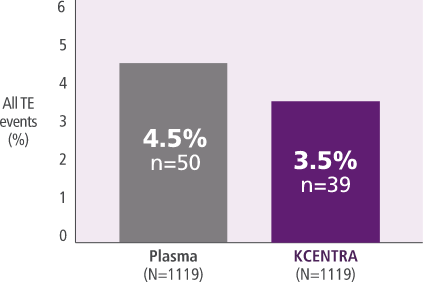
In sensitivity analyses, no significant adjusted differences in risk of TE event at 7- and 14-days post-treatment were seen between patients receiving KCENTRA vs plasma.
*aHR: 0.76, 95% CI: 0.49–1.16.

Secondary outcome
Adjusted all-cause mortality risk within 45 days posttreatment was significantly lower in those receiving KCENTRA compared with plasma2
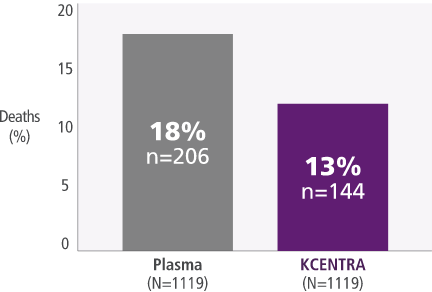

Risk reduction in adjusted all-cause mortality with KCENTRA vs plasma
In sensitivity analyses, the favorable association of KCENTRA compared with plasma for all-cause mortality was also observed at 7- and 14-days posttreatment
†aHR: 0.59, 95% CI: 0.47–0.73.
While this observational data demonstrated TE event safety, patients being treated with Vitamin K antagonist therapy have underlying disease states that predispose them to thromboembolic events. Please note the boxed warning regarding arterial and venous thromboembolic complications.